 Hisab Pagar

Key points
- Record each advance with its date and amount.
- Show recovery separately from salary earned.
- Keep the remaining balance visible to both owner and worker.
“Seth, ₹2,000 chahiye, ghar bhejna hai.” Almost every small business gives staff money before payday: for rent, a wedding, a hospital bill, or just to get to the end of the month. Advances are a kindness, but unrecorded advances are the most common cause of month-end fights. Here is a simple system for recording them, deducting them fairly, and keeping a balance both sides agree on.
The four things to write down, every time
Whether you use a notebook or an app, record every advance on the day you give it, with:
- Date: the day the money was handed over.
- Amount: in figures.
- Mode: cash, UPI or bank transfer. UPI and bank transfers leave their own record, which helps if there is ever a doubt.
- Note: the reason, and how it will be recovered (“deduct from September salary” or “₹2,000 a month for 4 months”).
For cash, ask the worker to sign the notebook entry or send a one-line WhatsApp message (“Received ₹2,000 advance, 5 Sept”). It takes ten seconds and removes any doubt later.
A simple advance register
| Date | Name | Amount (₹) | Mode | Reason / recovery |
|---|---|---|---|---|
| 5 Sep 2026 | Ramesh | 2,000 | UPI | Sent home. Deduct from Sept salary. |
| 12 Sep 2026 | Aslam | 5,000 | Cash | Child’s school fees. ₹2,500 in Sept, ₹2,500 in Oct. |
| 18 Sep 2026 | Ramesh | 1,000 | Cash | Deduct from Sept salary. |
Deducting an advance at month-end
At month-end, first work out what the person earned from attendance. Then subtract what they have already received during the month. The order matters: work out earnings first, then deductions. Never reduce someone’s attendance or days to “adjust” an advance.
Ramesh, September 2026
Monthly salary ₹15,000. With 22 present days, 2 half days, 2 absences and 4 Sundays off in a 30-day month, he earned ₹13,500 (₹15,000 ÷ 30 × 27 paid days). He took two advances.
Show him the three lines, not just the final number. A salary slip does exactly this.
Recovering a larger amount over several months
When someone needs more than a month’s balance, agree on monthly instalments before handing over the money, and write the plan down. For example, Sunita (₹600 a day) asks for ₹12,000 in July, to be recovered at ₹3,000 a month:
| Month | Earned (₹) | Instalment (₹) | Paid on payday (₹) | Still to recover (₹) |
|---|---|---|---|---|
| July | 15,000 | 3,000 | 12,000 | 9,000 |
| August | 14,400 | 3,000 | 11,400 | 6,000 |
| September | 13,800 | 3,000 | 10,800 | 3,000 |
| October | 14,400 | 3,000 | 11,400 | 0 |
The earned figure changes with attendance; the instalment stays as agreed. If a month is very short, because of illness for example, it is fair to talk and take a smaller instalment that month rather than leave the worker with almost nothing.
When the advance is more than the month’s pay
This happens often with new joiners and seasonal workers. Suppose a helper joins on the 16th, earns ₹6,750 for the rest of the month, but took ₹8,000 in advances. There is nothing to pay on the 30th, and ₹1,250 is still owed to you.
Do not leave this in your head. Write the ₹1,250 in the register as “carried to October”, show it on the September slip, and recover it from October’s pay as agreed. If the worker leaves before it is recovered, you at least have a dated record that both of you saw.
The same applies the other way round. If you paid less than was earned in a month, the unpaid balance is owed to the worker and should be paid or written down as carried forward, not forgotten.
Keep deductions fair and legal
- Agree before you deduct. The amount and the recovery plan should be clear to the worker at the time of the advance.
- Do not take everything. Indian wage law limits total deductions from wages. Under the Payment of Wages Act and the Code on Wages, total deductions in a wage period generally cannot be more than half of the wages. Spreading a big advance over several months keeps you well inside that.
- No interest on salary advances. Charging interest turns an advance into a loan business, with its own rules. Keep it simple.
- Settle when someone leaves. Work out the final month’s earnings, subtract what is still outstanding, and give a final slip showing both. If more is owed than earned, write down the remaining amount and get it acknowledged.
This is general information to help you keep good records, not legal advice. Rules can differ for your business and state.
Advances, bonuses and penalties are different things
Keep them on separate lines. An advance is part of the salary paid early, so it is subtracted from what is due. A bonus is extra money on top. A penalty (for example for damage) reduces what was earned, and should be rare, agreed and written down. Mixing them in one “adjustment” figure is how trust is lost.
How Hisab Pagar tracks advances
- Open a staff member and add a payment. Choose the type (salary, advance, bonus or penalty), the mode (cash, UPI or bank transfer), the date, and an optional note.
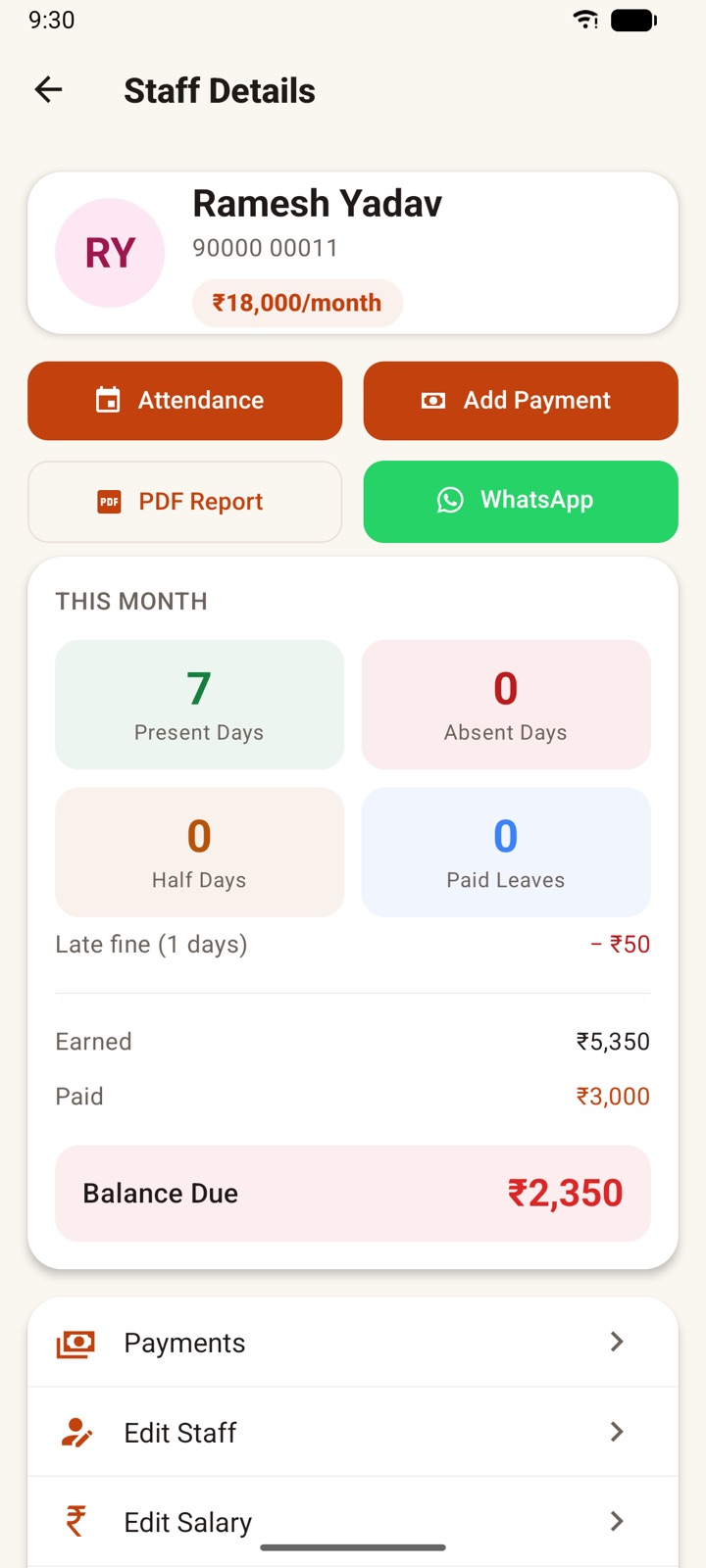
- The Salary Due screen shows each person’s earned, paid and balance for the month. Advances and salary payments dated in that month are subtracted from that month’s earnings, and penalties are deducted from what was earned. In the example above it shows ₹10,500 due for Ramesh.
- If someone has been paid more than they earned that month, the balance shows as an Advance instead of an amount due, as in the ₹1,250 example above.
- The salary slip lists every payment with its date, type, mode and amount, so the worker sees each advance.
Hisab Pagar settles each month on its own: it does not keep a running loan balance across months. For a large advance recovered in instalments, a simple way is to record only the instalment as an advance in each month it is recovered, with a note such as “₹12,000 given 3 July, instalment 2 of 4”. Do not also enter the full ₹12,000 as one payment, or the first month will show all of it as recovered.